As the largest city in Switzerland and a worldwide financial hub, Zurich lives up to a reputation described by one travel agency as “A sophisticated city with cosmopolitan luxury and an incredible atmosphere.” Statements like these are commonplace on the websites and brochures of hospitality industry businesses looking to claim a percentage of a person’s travel expenses. Yet in the case of Switzerland’s “city by the lake”, the description of its personality held true. The general vibe of Zurich is exactly what most people imagine it to be: wealthy pompousness, European conservatism, grand historic architecture, German punctuality, and Swiss mountainous beauty all in combination to bring the immaculately clean city to a consistent level of positive energy. The average person notices immediately that they could never afford to live in Zurich; but after just a few hours of exploring, they realize why: the city just seems to have gotten it right. In contrast to several “impossibly unaffordable” municipalities in the United States also being known for crime and blight, the high cost of living in Zurich is plainly the result of prosperous individuals seeking to keep it as safe and luxurious as they can. After some sad and disappointing trips to once-thriving major U.S. cities that have become wastelands, I was looking forward to seeing Switzerland do it properly. I had to get there first, though.
Source: Dark Passport Photography
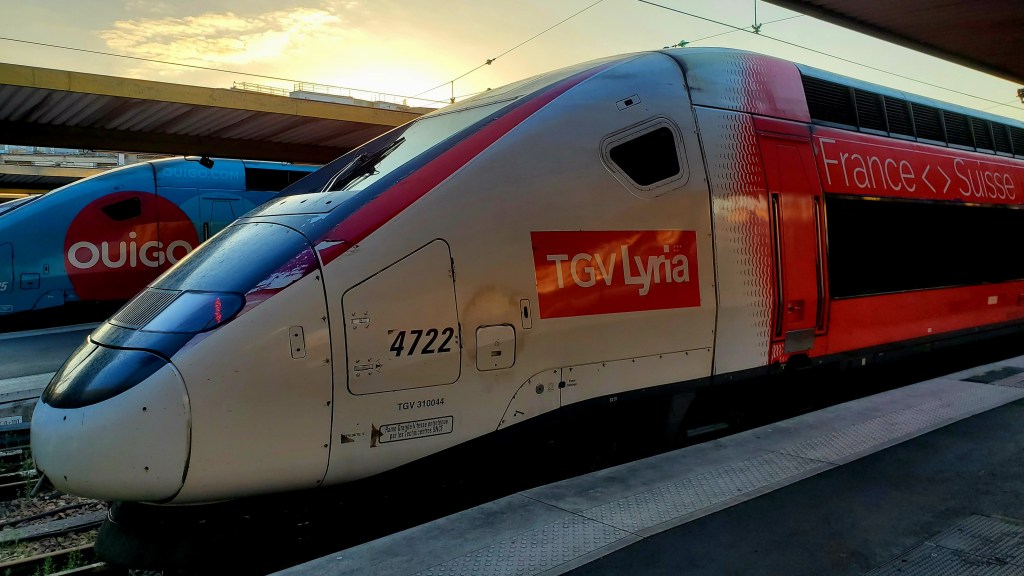
The Train a Grande Vitesse (“high-speed train”) or simply TGV is the French rail transportation service that conducts intercity as well as international routes in certain parts of Europe. TGV locomotives are powered by electricity which is collected by a pantograph that extends upward to overhead lines. The train speeds vary, with the route to Zurich topping out at 320 kilometers per hour (199 miles per hour).

Source: Dark Passport Photography
The trains accelerate and decelerate from high speeds at a very gradual rate that is nothing like the feeling of taking off or landing in an airliner. The turbulence felt in an airplane is absent, and the seats in coach are roomier. Train stations are almost always located in the city center and lack the lengthy security screening processes associated with air travel. The resulting experience of getting from Point A to Point B on European rail is one of comfort and efficiency, not to mention the benefits to the environment. Lastly, with the ironic exception of Germany, rail travel in Europe tends to be quite punctual and otherwise reliable.
Source: Dark Passport Photography
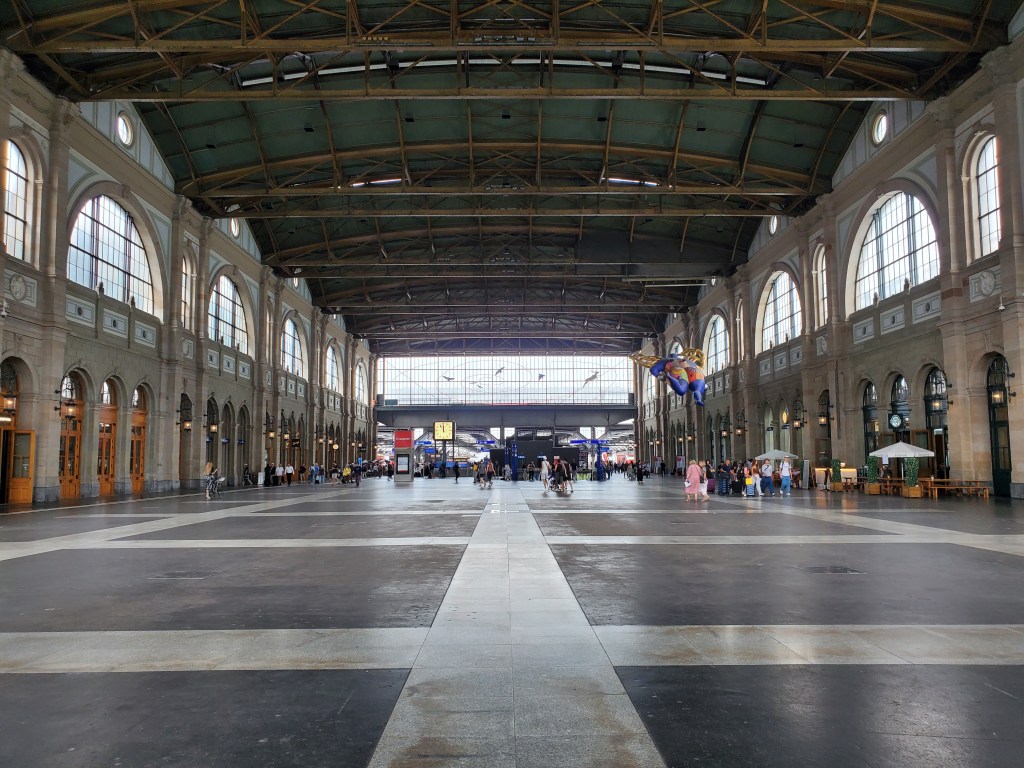
The old main hub European train stations are, more often than not, architectural works of art. The German word for a main/central train station is hauptbahnhof, commonly abbreviated to “HB” or “Hbf” on maps and signs. The neoclassical Zurich HB has been ranked as the best rail station in Europe, in addition to being one of the biggest and busiest. The large open space or haupthalle in the picture above is where the original trainshed was located from 1871 until 1933, at which time the tracks and platforms were relocated a couple hundred yards away (visible in the far background of the picture). The open area is occasionally filled with the bodegas of vendors, especially during the Christkindlimarkt, but the real shopping experience is in the attached ShopVille-Zurich underground mall where nearly 200 shops line the passageways. Of course, it is easier to shop without dragging around luggage.

Source: Dark Passport Photography

Source: Dark Passport Photography
In the United States, the term “budget hotel” makes the imagination wander with thoughts of bedbugs crawling on musty stained sheets. We have been conditioned by the hospitality industry to accept nothing less than a 50-inch flat-screen television above a king bed with remote controlled curtains opening to a view of a resort style swimming pool surrounded by bungalows with chairside service. But people don’t visit Europe for the hotel life. Small rooms with even smaller beds and outdated furnishings are common and acceptable in picturesque cities with centuries-old culture. The 5-star accommodations exist just like anywhere else in the world, but they are unnecessary when travelers are inclined to spend 14+ hours per day outside exploring their surroundings.

Source: Dark Passport Photography

Source: Dark Passport Photography
The predominant German influence in Zurich means hearty, savory cuisine with plenty of meat and potatoes along with tangy sauces. One of the most famous restaurants in Zurich is Zeughauskeller. The term zeughaus means “armory” and is a callback to the original purpose of the building which was erected in 1487 to store weapons for the battles fought by the Swiss Confederation in the late Middle Ages in an effort to reinforce their fledgling independence. Not to worry, by 1926 the tools of battle were removed and the suffix keller (“cellar”) was added to the name to indicate its new life has a traditional beer hall. After being seated among strangers in true hofbrauhaus fashion, I opted for the wurstspiess (“sausage skewer”) served with onion sauce alongside potato salad. I wasn’t concerned about ordering a beverage though.
Source: Dark Passport Photography
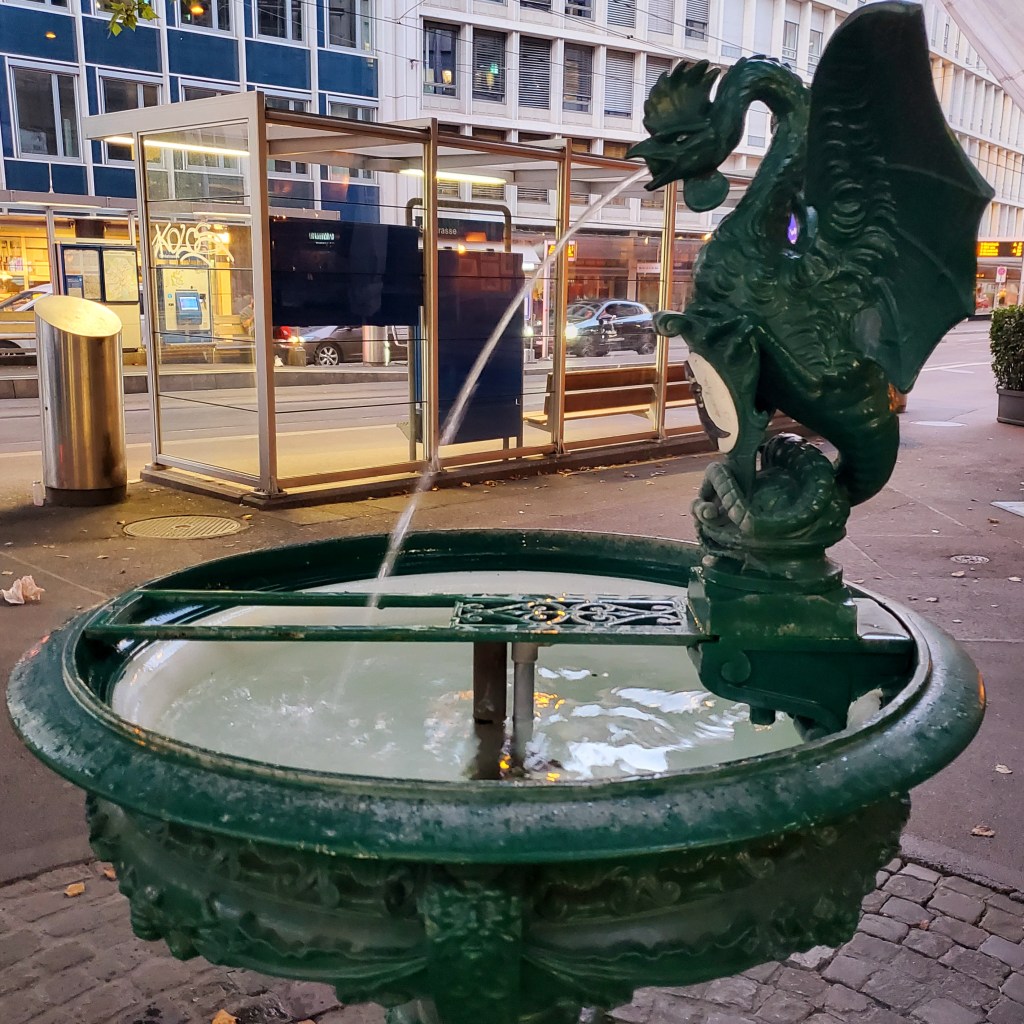
There are more than 1,200 public fountains in Zurich, each with a steady stream of clean spring water meant for drinking. In contrast to most American public water fountains spewing a weak bubbling liquid that tastes like sand and is primarily used by homeless people for bathing, the fountains all throughout Switzerland are routinely used by all classes of the socioeconomic hierarchy. Pictured above is a basiliskenbrunnen (“basilisk fountain”) featuring the fabled basilisk creature with the head of a rooster, wings of a dragon, and tail of a serpent. Basilisk themed water fountains originated in the neighboring Swiss city of Basel as a result of local folklore. The horizontal metal bars spanning the rim of the fountain bowl are designed to support a portable wash basin or other large container that locals would historically fill and bring back to their homes or storefronts to have fresh water for the day. One of Zurich’s fountains, shown in later photograph below, can even dispense wine!
Source: Dark Passport Photography
Source: Dark Passport Photography
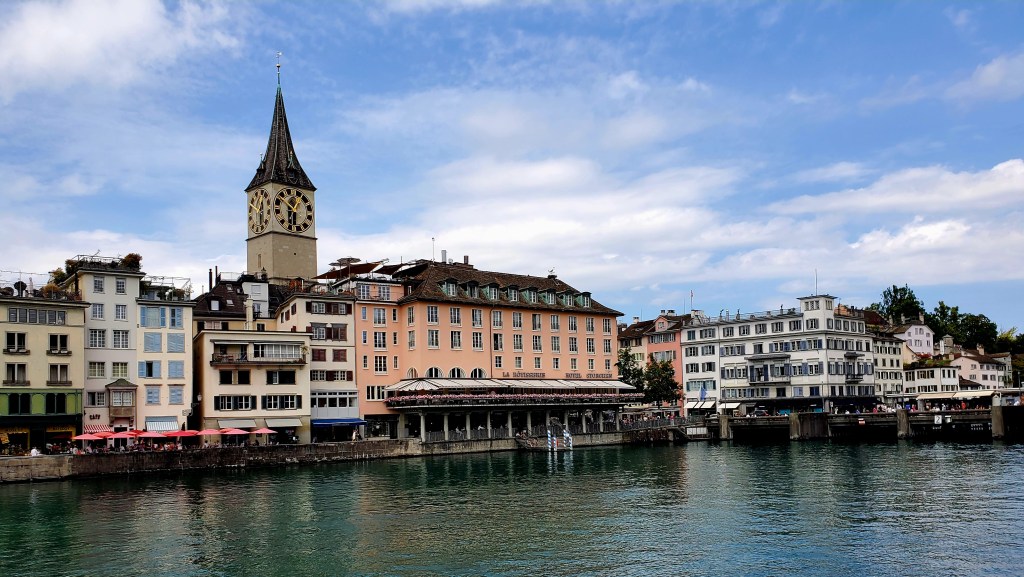
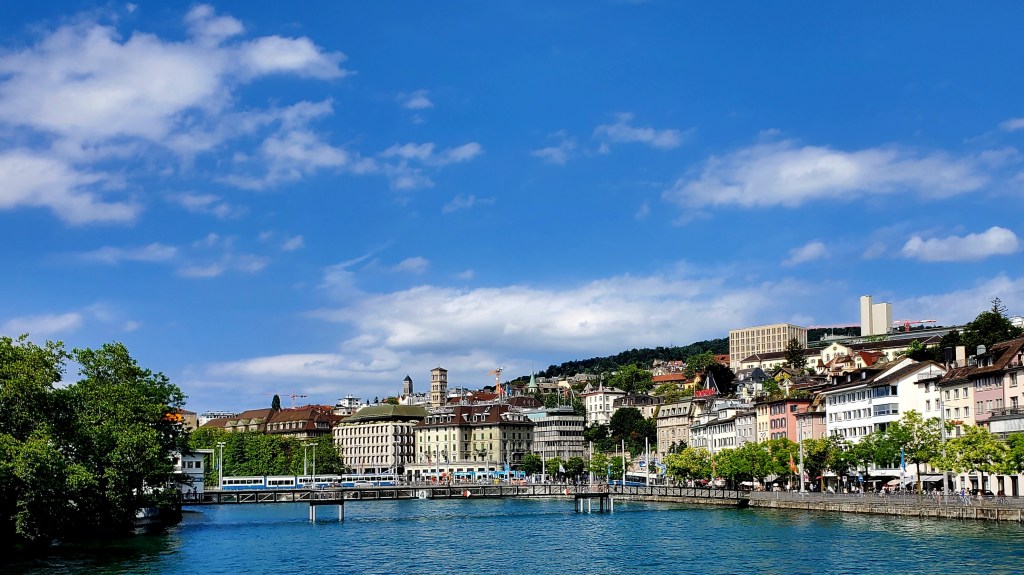
Even before the addition of 1,200 fountains, water was not hard to come by in Zurich. Apart from the gigantic Zurichsee (“Lake Zurich”), the Limmat River splits the city into two halves. A visit to Zurich without a walk along the Limmat River promenade is practically sacrilegious. The first picture above shows a view of the eloquent Storchen hotel with the Limmat in the foreground and the bell tower of St. Peter’s Church rising in the back. The original church was built around the 9th century, while the structure seen today boasts the largest diameter church clock in all of Europe. The second picture, also of the Limmat, was taken from the Rudolf-Brun Brücke (“Bridge”) which is understandably a popular selfie spot. But wait, there’s more to Zurich’s water features than the lake and river.
Source: Dark Passport Photography

Source: Dark Passport Photography
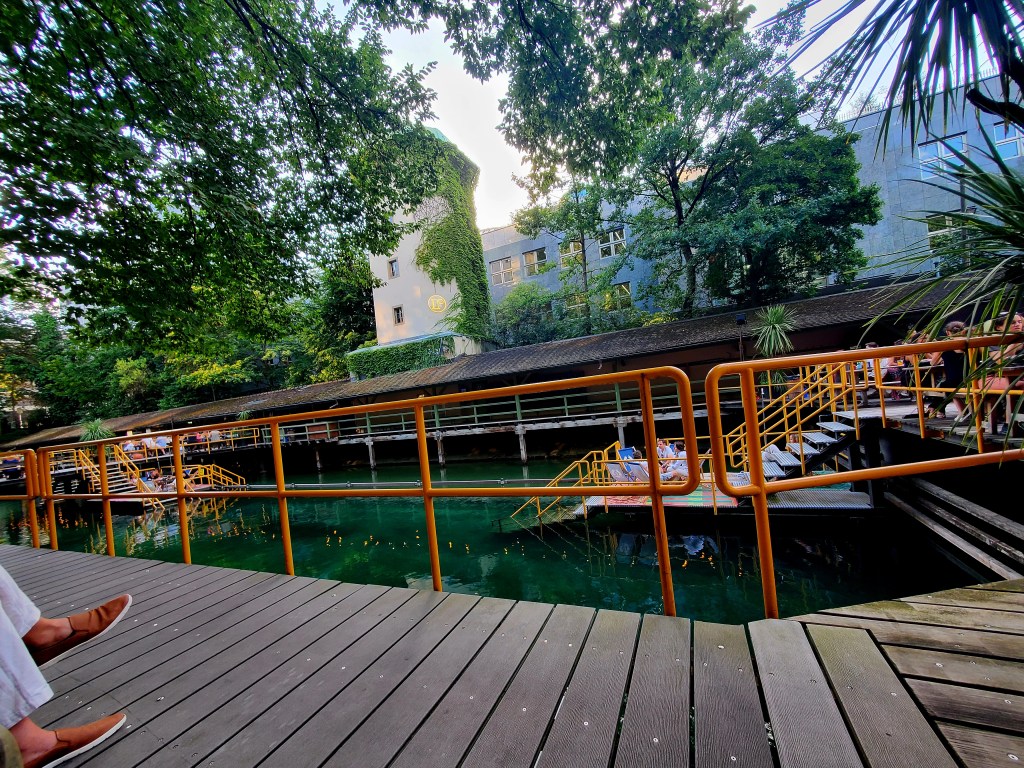
The Swiss badis are difficult to describe. The German root of the word means “bath”, but badi is actually of a Swiss German dialect and has outgrown its literal translation to essentially mean a sort of outdoor swimming hole. But going to a badi isn’t what you and I think of when we say we’re going to the pool. In Switzerland, going to a badi during the summer is a ritualistic lifestyle.
“Everyone – and I mean everyone – is out in the lake, or by the lake, or in the river, or by the river. It’s like the whole city adopts this freeing, ‘anything goes’ attitude. The entire vibe of Zurich transforms…”
–Alexandra Bornhoft of Wander We Go
Apart from Americans not understanding the laidback summer culture of Zurich, another reason badis are difficult to describe is because no two are exactly alike. Some are on the lake, others on the river; some cater to families while others are basically nightclubs along the water. And each resident of Zurich has their own preference. One example is the Mannerbad Badi and Rimini Bar along Zurich’s Schanzengraben (“entrenchment”) which is a 17th century moat that has since been turned into a canal. During the summer daytime hours, the facility is known as Mannerbad (“menfolk bath”) and is a men-only badi to swim and relax in. As the sun begins to go down, a metamorphosis happens. Swimmers hop out of the pool and put clothes back on, women are allowed inside, bars and a restaurant open, and the name becomes Rimini Bar. But in spite of nearly the entire populace of the city essentially taking the summer off to lounge at the badis, there remains still plenty of opportunity for shopping and sightseeing.
Source: Dark Passport Photography

Source: Dark Passport Photography
Source: Dark Passport Photography
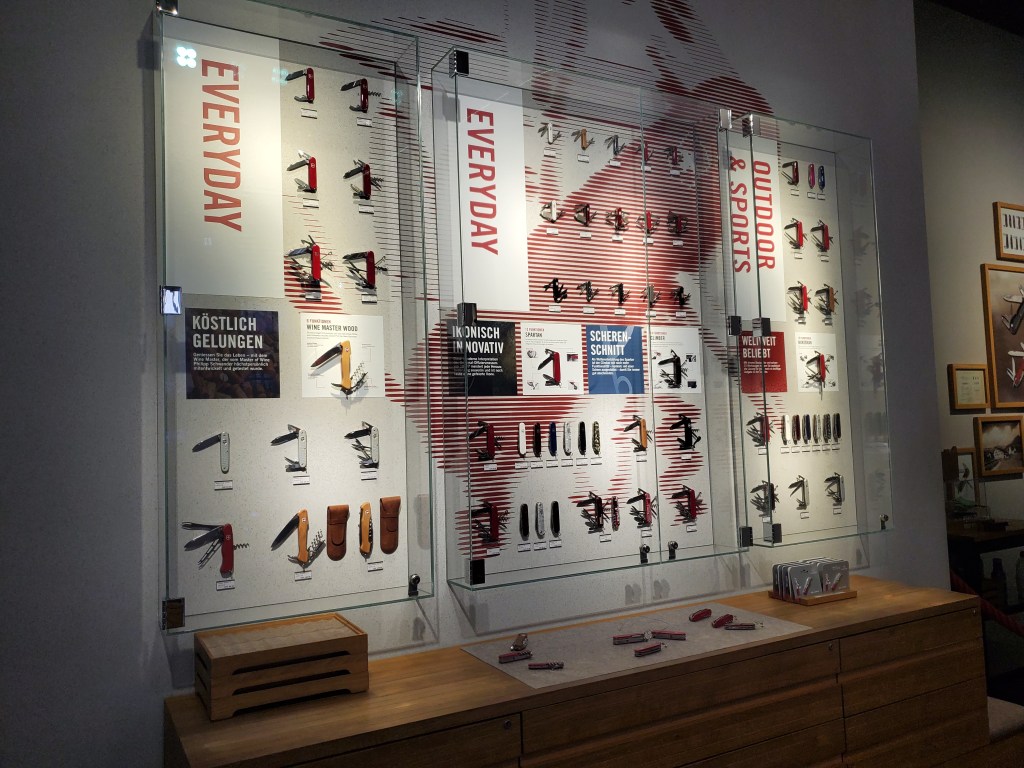
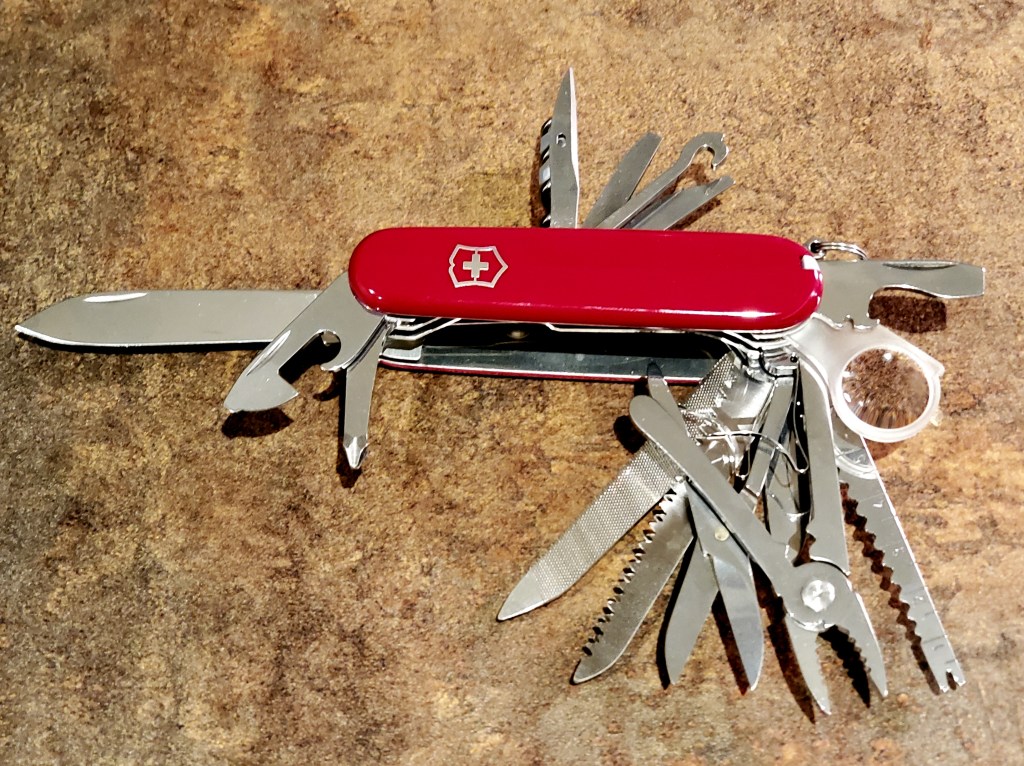
The famous Bahnhofstrasse road is one of the most expensive streets in the world in terms of shopping. It is the Switzerland version of New York’s Fifth Avenue or the Avenue des Champs Elysees in Paris. And while I don’t make a habit of traveling around the world just to go shopping (especially on streets that rival Rodeo Drive), I couldn’t resist visiting the Victorinox flagship store and buying a needlessly large Swiss army knife. Since it’s Switzerland, there are also plenty of chocolate shops scattered between the designer fashion boutiques.
Source: Dark Passport Photography
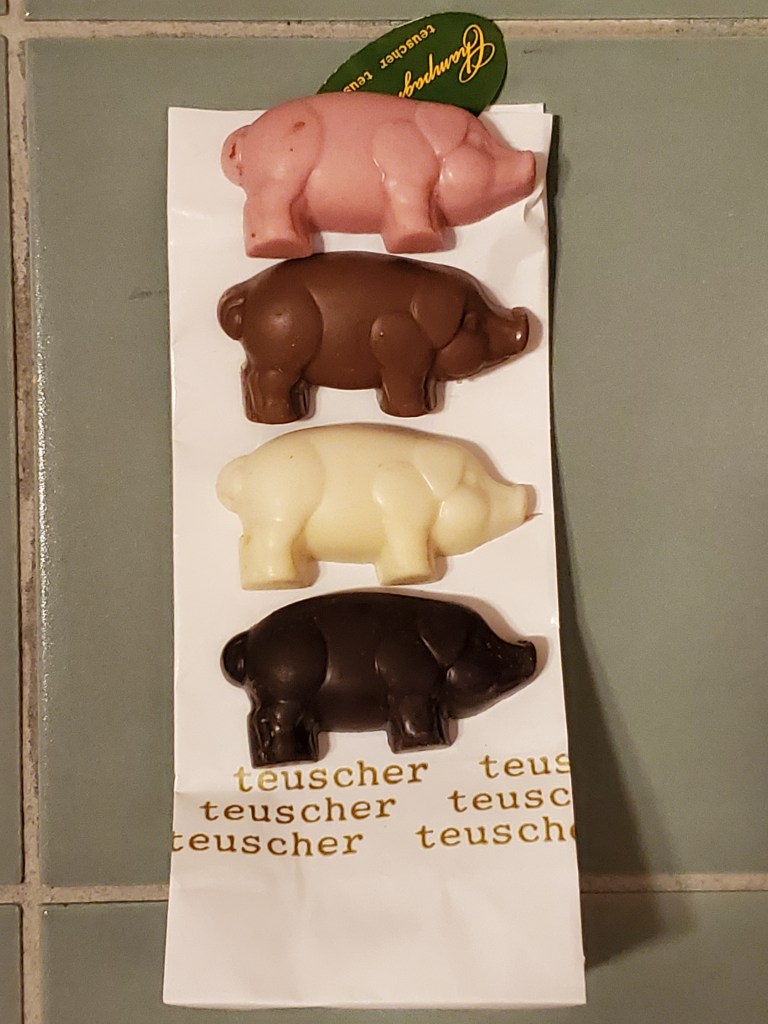
Teuscher Chocolates of Switzerland (pronounced “toy-sher”) is a Zurich-based chocolatier that has been in operation since 1932. In addition to the flagship Bahnhofstrasse location, the recognizable name can be found in a handful of large cities throughout America. Teuscher is most famous for their delectable champagne truffles made with Dom Perignon, but they also make over 100 other varieties of chocolates and similar confectionery treats. The truffles are not cheap, but they are fantastic. Supposedly they are flown weekly from Switzerland to all the Teuscher stores throughout the world. What better way to get a small boost of energy while exploring the architecture of Zurich.

Source: Dark Passport Photography
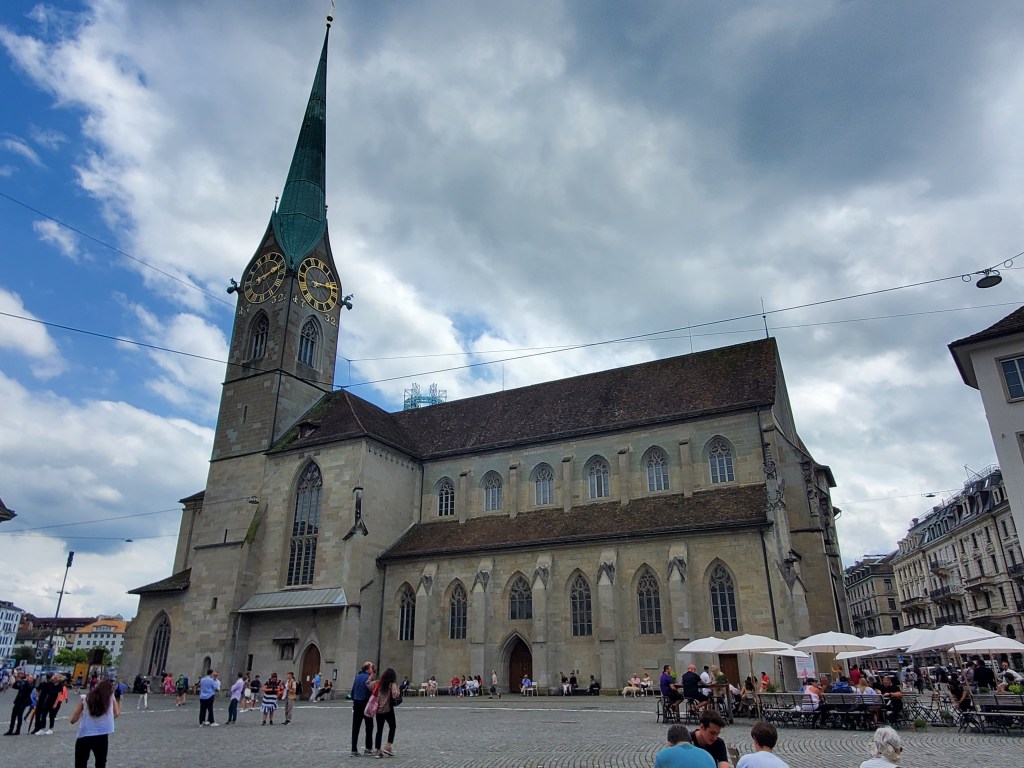
The Altstadt (“old town”) of Zurich is anchored by the Münsterhof (“church yard”) town square in which the classic European café life is on continuous display. Partially in-frame of the above picture is the Münsterhof’s fountain which can actually be converted to dispense white wine on special occasions. The blue building in the same picture is the Zunfthaus zur Waag restaurant which was built in 1637. Implied by its name, the centerpiece of the Münsterhof plaza is the historic Fraumünster Church.
Source: Dark Passport Photography
The site of Fraumünster (“women’s church”) has undergone regular construction and remodeling since King Louis the German founded it for aristocratic women in 853 CE. Although the church became victim to the 16th century Protestant Reformation, most of the architecture that can be seen today is from either the High Middle Ages when the abbey was in its prime (11th-13th centuries), or from its 20th century modernization. The damage done by the Reformation was mostly to the interior, the Protestants having removed anything with an ode to Catholicism. Ironically, one of the most popular attractions of the church are the Marc Chagall stained glass windows that weren’t installed until the 1970s. Fraumünster naturally isn’t the only historic church or set of stained glass windows in Zurich, however.
Source: Dark Passport Photography

Source: Dark Passport Photography
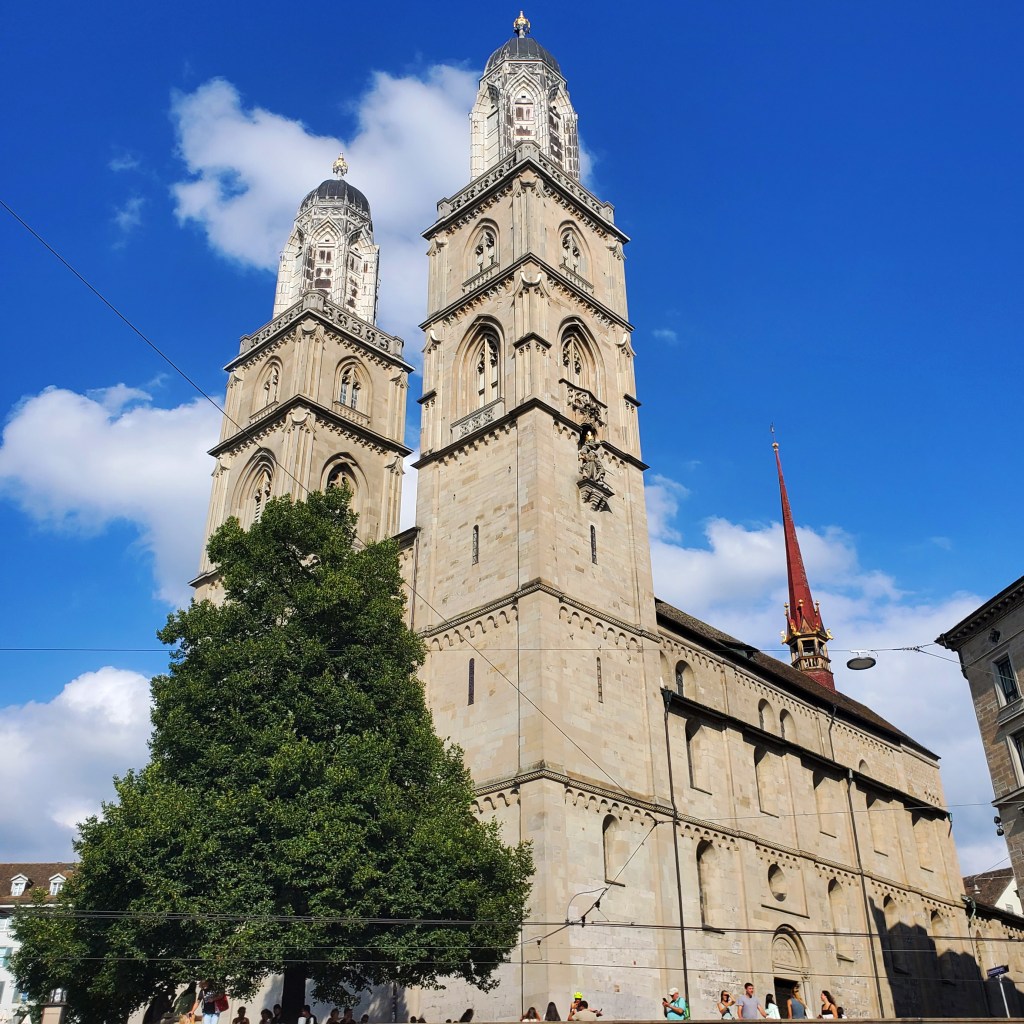
The aptly named Münsterbrücke (“cathedral bridge”) shortens the walk across the Limmat River from Fraumünster to Grossmünster (“grand cathedral”) to a mere 2-3 minutes. While the earliest bridge in the area dated back to the Roman era, the current structure was built in the 1830s. Both churches competed with each other through the ages, although legend has it that Grossmünster was built upon the graves of the patron saints of Zurich by order of Charlemagne. Much of the current building was inaugurated around the year 1220, with the exception of the iconic towers which were added in the late 1400s. Similar to its rival church across the river, the interior of Grossmünster is somewhat bare due to the destruction of the Reformation. The 1933 addition of stained glass to the chancel by Augusto Giacometti was a welcome burst of color, depicting the Virgin and Child along with the Magi and angels (pictured above).
Source: Dark Passport Photography
Wholesome food, interesting history, and beautiful scenery. It was a privilege to experience Zurich. Speeding away from Switzerland through the Alps in a bullet train, I couldn’t help but muse, “I’ll be back one day.”
 The Dark Passport