“San Francisco is a lot of things. It’s hippies, hipsters, vagrants, flagrants, artsy, fartsy, and more. You name it, and it probably lives here.” – The Bold Italic Magazine
In 1989, the growing independence and importance of the Asia-Pacific region was brought to formal recognition by 12 countries intent on combining their successes, ideas, and efforts. Australia, Brunei, Canada, Indonesia, Japan, South Korea, Malaysia, New Zealand, the Philippines, Singapore, Thailand, and the United States became the founding members of the Asia-Pacific Economic Cooperation (APEC).
What has evolved to a now 21-member coalition began simply as a semi-formal means for economic leaders of various countries to meet and have dialogue about sustainable and responsible growth in their region. As we speak, the APEC member economies account for 60% of global trade and nearly 40% of the worldwide population. APEC Leaders’ Week is an annual summit, hosted by a different country each year, to formally promote fair trade and economic prosperity while engaging global challenges. The United States chaired and hosted APEC in 2023, and the culminating Leaders’ Week was held in San Francisco in November.
San Francisco, or “SF” (don’t call it “Frisco”) is, on paper, the epitome of APEC. It is the fourth largest economic region in the United States with nearly 40 companies from the Fortune 500 list headquartered there. One-third of its population is Asian, and its famed Chinatown is the first and oldest in the country. You will also find the Asian Business League and the Asia Foundation based there. It is home to 70 foreign consulates. It is inclusive and culturally diverse. It is resilient. But it’s also notorious.
Once upon a time, risky activity in San Francisco was purely based in Hollywood: Detective Frank Bullitt chasing two cop-killers in his 1968 Mustang, Dirty Harry’s day [not] being made while interrupting a bank robbery, or at worst, Catherine Tramell uncrossing her legs during a police interrogation (you can look that one up on your own). The current reality is starkly less entertaining. Rampant homelessness and drug abuse along with government apathy have led to Downtown SF’s highest retail vacancy rate since the Great Recession. The city’s own chamber of commerce president recently admitted, “We no longer manufacture things in San Francisco to speak of.” A stroll along sidewalks lined with tents, littered with used needles, and covered in human excrement leads to America’s most robbed Walgreens. Surprising when you consider how San Fran is among the 10 most expensive cities on the planet. Not exactly the vision the United States wants world foreign economic leaders taking back to their homeland.
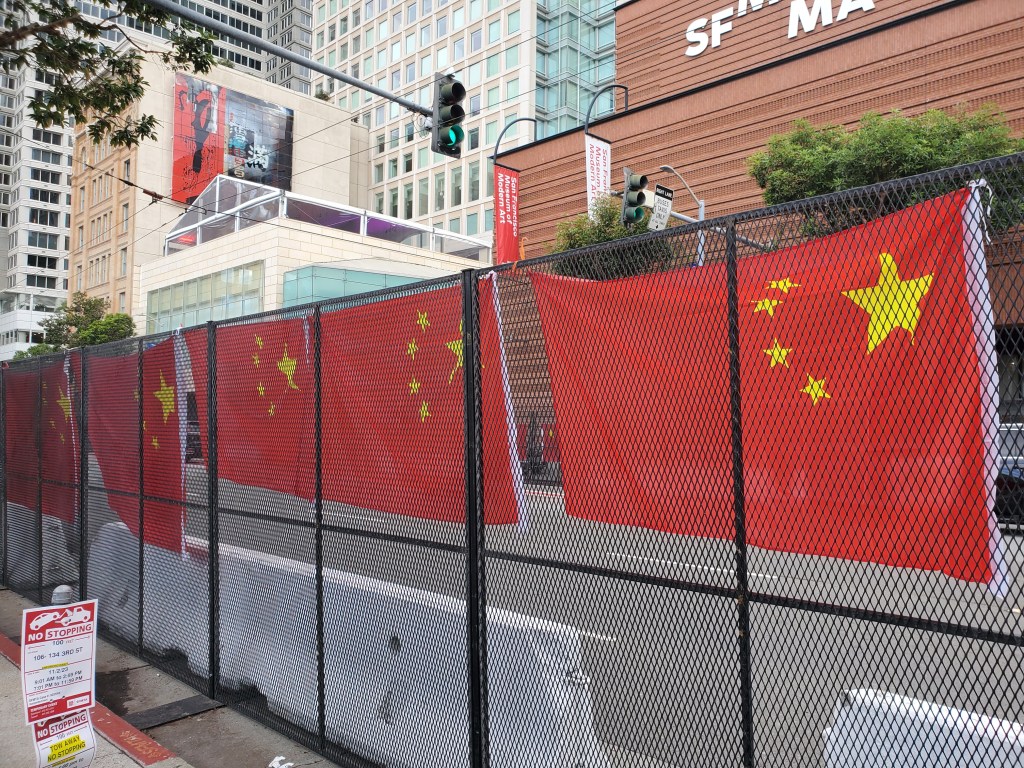
The areas of San Francisco nearest to APEC were turned into a Potemkin Village for a week, giving a false image of cleanliness. California Governor Gavin Newsom even went as far as admitting that the hasty clean-up of SF was directly related to the visiting foreign dignitaries. Nevertheless, the leaders of the free world (and a few communists) descended upon the Bay Area for the APEC ministerial meetings and the 30th Leaders’ Week summit. That, of course, required my coworkers and I to attend as well.
APEC marked the first time in approximately one year since U.S. President Biden and President Xi Jinping of China had an in-person meeting, and the first time since 2017 that Xi had visited the United States. Tensions were understandably high given the state of world affairs. Even those issues unrelated to the Asia-Pacific region found their way to area due to it being on the world stage.

Source: Dark Passport Photography
Source: Dark Passport Photography
The importance of what the Asia-Pacific Economic Cooperation is trying to achieve cannot be overstated. The device you are reading this from, the clothes you are wearing, the food in your pantry, the car you drive; all are made entirely in or at least dependent on one or more of the non-U.S. countries in the consortium. To put it in perspective: Nearly 25% of the total crops grown on American farms are exported to foreign countries after being harvested with tractors containing foreign components that are powered by a fuel supply that is 35% foreign. Ninety percent of the rubber used to make the tires American tractors roll on comes from Southeast Asia. The American farmers wear apparel and footwear of which 98% is produced overseas. This is but one small analogy illustrating how, whether we like it or not, we as U.S. citizens depend on other countries and vice-versa. APEC helps ensure the success of this reality. And for one high level week in November, the U.S. government facilitated the dialogue. I, for one, was proud to do my part, albeit in less-than-ideal conditions.
In the sequel to this blog, #31: San Francisco, I focus on the sightseeing aspect of my time in California.
 The Dark Passport