Note: The events described below took place prior to the October 7, 2023 terrorist attack in Israel and the ensuing actions of representatives at the United Nations Security Council meetings which have been the subject of much criticism.
Nearly 200 flags stood waving in the cool September breeze coming off the East River which separates Queens from the sprawling metropolis of Manhattan. The vibrant colors representing their respective countries contrasted magnificently with the clear blue sky and the glass façade of the UN Secretariat skyscraper. As I marveled at the imminent significance of the UN Plaza from my 44th Street & 1st Avenue vantage point, I overheard a child ask his parents, “What is the United Nations?” It was a good question, I admitted; one that isn’t easily articulated by the average person. Indeed, the boy’s parents gazed upward in search of an answer. What they saw was a platoon of clean cut 30-somethings in neatly pressed suits. They didn’t know exactly who we were, but anyone could tell why we were standing there. “These folks can probably explain it to you better than we could, son.”

The young man with the inquisitive facial expression was of elementary school age. I seized the opportunity. “Think of all your friends at school” I said as I leaned down towards his level. “You play with each other and share your toys. You learn how your family is different from theirs. They might even look different than you. But you all still get along.” I could tell he was thinking about the playground, or perhaps the cafeteria. “Now imagine a globe, and all the countries on it. Almost two hundred of those countries are friends.” His eyes widened. “They help each other. They strive for world peace and climate change. They do this despite speaking different languages and having different skin colors. They call themselves the United Nations.”
The boy abruptly asked, “Does the United Nations stop war?” For his age, I was surprised at this question. His parents must have noticed. “At school they recently learned about the people in Ukraine who are suffering right now.” His mom told me. “They didn’t think it was fair.”
I turned back to the boy and affirmed, “The United Nations can help stop war. But they’d rather prevent it from happening in the first place. In fact, it was the devastation of World War II that made all the countries come together and decide to be nice to each other.” He was processing a lot of information. I saw another opportunity. “Do you know the President’s name?”
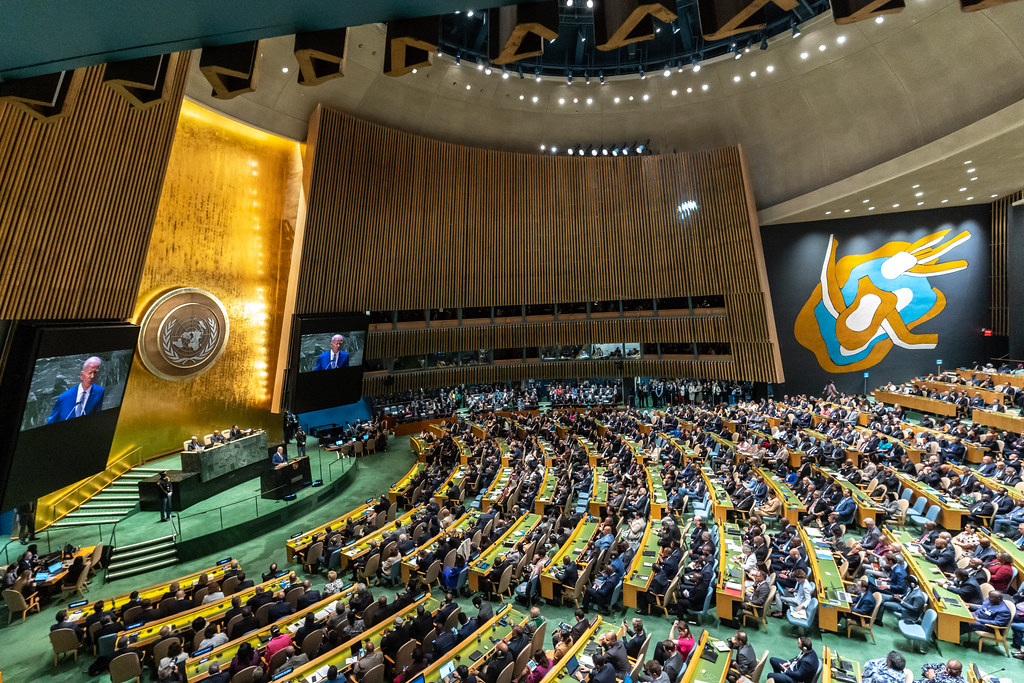
Photo: “UNGA 2023 – Tuesday” by Ministerie van Buitenlandse Zaken is marked with Public Domain Mark 1.0.
“Joe Biden!” The boy exclaimed with jubilee.
“Very good.” I said, “And he’s actually in that building right now.” I pointed toward the General Assembly Hall. The boy strained to look, as if he might catch a glimpse. I continued, “The President of Ukraine is there too. He is asking President Biden, and many other presidents and kings, for help. Because every year, all the world leaders come right here to New York City for one week to make friends and support each other, despite all of our differences. It’s called the United Nations General Assembly.”
The depth of his next question surprised me yet again. “What countries are you friends with?” The bright young man had caught on quick. Even his parents looked to me and my coworkers with curiosity.
“This year, I made friends with Middle Eastern countries.” The term friends was starting to become distorted, but the boy was still a few years away from his first lesson in geopolitics. “The United States tries to be friends with everyone.” I continued, “That’s why so many countries come here each year. And it’s my job to make sure they are safe and polite to each other. I also look for people who aren’t our friends.” The boy’s parents, making the connection between what I just said and the growing presence of protesters on the nearby sidewalks, sensed it was time to move on.
Tying a lesson together with parting thoughts evoking applicability and practicality is an important part of teaching. “One day,” I said to the young gentleman as he prepared to depart, “You could work at the United Nations or for the U.S. government, traveling the world making friends with other countries. You can stop war, hunger, and corruption.” I paused for effect. “You can be the one to make the change.”
In light of recent events, it is easy to question the benefits of global collaborations such as the United Nations. It is even easier to ask why the United States feels compelled to be involved in the problems of other countries. All we have to do is turn on the television and become embroiled in the negativity spreading throughout the globe. Is it a few bad actors and the media fueling the divisiveness? Or is our insistence on making the world a better place (as we see it) actually doing our neighbors and our own country more harm than good? The infancy of my career in foreign affairs offers no answer in this forum. What I do know is the feeling of accomplishment that comes with being one of many thousands of diplomats who work every day to maintain our way of life while trying to bequeath to less fortunate people the peace, prosperity, and other values we as Americans cherish.
 The Dark Passport